
Conversation 3
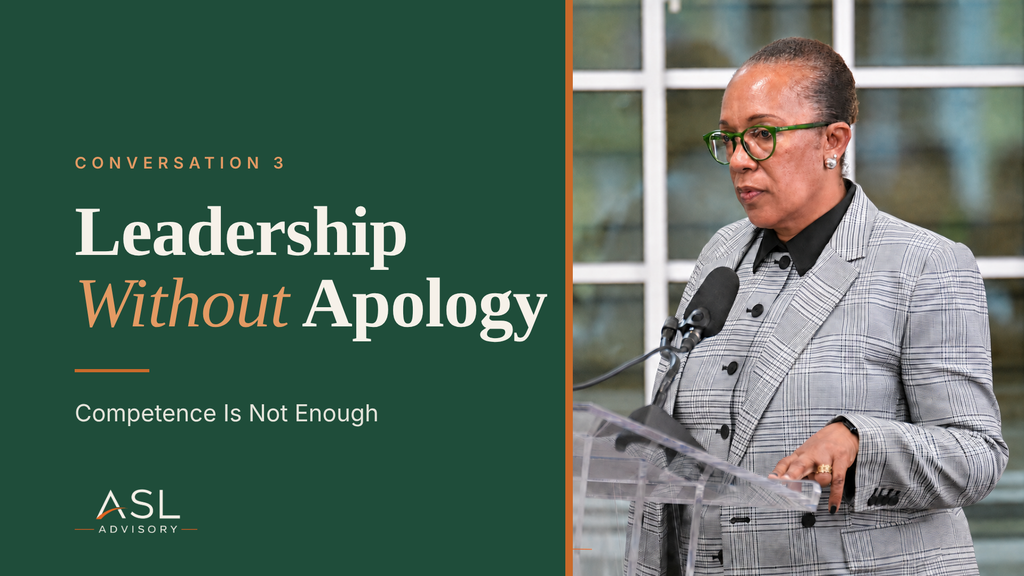
Getting the role requires competence. Succeeding in the role requires influence.
It took me a long time to learn that, and I learned it more than once.
Don’t Blow Your Own Trumpet
I grew up in the Caribbean with a lesson many of us will recognise:
“Don’t blow your own trumpet.”
Work hard. Do what you are supposed to do. Let the quality of your work speak for itself.
For women, there was another layer. You were expected to be capable, but modest about it. You certainly did not go around talking about how good you were or why you deserved recognition. You let other people notice your contribution.
That was very much how I was raised, and I carried it into my career without realising how deeply it had shaped me. I am sure that many other women share that same sentiment.
A Lesson I Have Never Forgotten
In 2000, a woman who was training me for a role showed me her performance assessment.
As I read it, I asked her, “But why are you talking about yourself like that? That’s your work. That’s your job.”
Her answer stopped me.
“No. That’s not in my job description.”
She had documented everything she had done beyond what was expected of her to achieve those results.
I had never thought about performance that way. I had never given myself an Exceeds Expectations rating. Not because I was not exceeding expectations, but because I believed that whatever I did to help my organisation succeed was my job. Why would I praise myself for doing my job?
She encouraged me to identify what I had done beyond my job description, the results I had helped create, and the value I had added, which fostered pride and confidence.
And she told me something I needed to hear: “You have to let people know what you have contributed. Nobody is necessarily going to do that for you.”
Humility and Invisibility Are Not the Same Thing
I did not suddenly become comfortable blowing my own trumpet. I am still not.
But I began to understand the difference between boasting and being able to articulate your value.
Some people enter the workplace already comfortable saying: I achieved this. I led this. This happened because I initiated it.
For many women, those words feel uncomfortable. Not because they are untrue, but because we were taught that good women did not talk about themselves that way.
If one person clearly explains what they contributed while another quietly assumes everyone already knows, the second person’s contribution becomes less visible.
I believe humility is a strength, but women often wonder how to balance it with self-promotion without feeling inauthentic or boastful. Articulating your value doesn’t mean abandoning humility; it means confidently sharing your contributions in a way that feels genuine and aligned with your values.
Passing It On
When I became responsible for writing performance appraisals, I saw the same pattern in my own staff. The culture didn’t encourage people to talk about what they had done, so they didn’t.
So I started keeping notes. Whenever someone did something commendable, something above and beyond their normal responsibilities, I wrote it down.
When we sat down for their performance assessment, I would often say, “You left this out. And you left that out as well.”
More than once, the response was, “Oh my, you remember that?”
Yes, I did. They went above and beyond what their role required, and they deserved to be recognised for it.
It was one small way I could do for others what that woman had done for me in 2000.
Good Work Does Not Always Speak for Itself
In Conversation 1, I shared the story of a paper I wrote as a new senior leader. No one responded. After I left, they implemented my recommendations.
Looking back, I can see what went wrong. The changes made so much sense to me that I expected them to be adopted. Perhaps the timing was wrong. But I had spoken to only one person before submitting it, and I didn’t realise this individual didn’t have the influence I assumed. I had prepared the paper carefully, but I had not prepared the ground.
Years later, I needed to make major, costly changes for an organisation to move forward. This time, I approached it differently. I broke the changes down to show the bigger picture. I thought carefully about each stakeholder group: what would resonate with them, what wouldn’t, and what was in it for them. I shaped the paper around those answers and supported it with evidence.
It worked.
My competence had not changed much between the first paper and the second. My understanding of influence had.
“If You Want to Move Up, You Need a Sponsor”
Later in my career, I watched other people being promoted. If I am candid, I sometimes thought: I know what I can do. I know the quality of my work. What am I missing?
Then someone told me, “If you want to move up, you need a sponsor.”
That was difficult for me to understand. What did having a sponsor have to do with whether I could do the job?
Eventually, I understood. A mentor advises you. A sponsor speaks up for you in rooms you are not in.
Research supports this. Herminia Ibarra, Nancy Carter and Christine Silva, writing in the Harvard Business Review in 2010, found that high-potential women were more likely than men to have mentors, yet were not advancing at the same rate. Men’s mentors tended to be more senior and more likely to advocate for them. The researchers concluded that women were over-mentored and under-sponsored.
I also came to understand that sponsorship isn’t about asking someone to give you something you haven’t earned. A good sponsor is not manufacturing your competence. They have seen it. They trust it. And they are willing to put their own credibility behind your potential.
I wish I had understood that earlier.
What Have I Learned?
Work hard. Know your craft. Deliver.
But do not disappear behind your work.
Learn to articulate your contribution.
Understand how decisions are really made, and who really makes them.
Show people what is in it for them, and bring evidence.
Build relationships before you need them to create a sense of support and security for your career journey.
Building relationships with potential sponsors can seem daunting. Seek out opportunities to demonstrate your value, network intentionally, and find common ground with senior leaders who can advocate for you. Developing these connections takes time but is essential for career advancement. And when you lead others, notice what they do, and make sure it is recognised.
Next week, we will talk about something few leaders discuss openly: the loneliness of senior leadership.
For now, this week’s question is not only, “Am I competent?”
It is this:
Do the right people understand the value I bring, and am I comfortable enough to say it myself?
I would love to hear your perspective.
