
Conversation 2
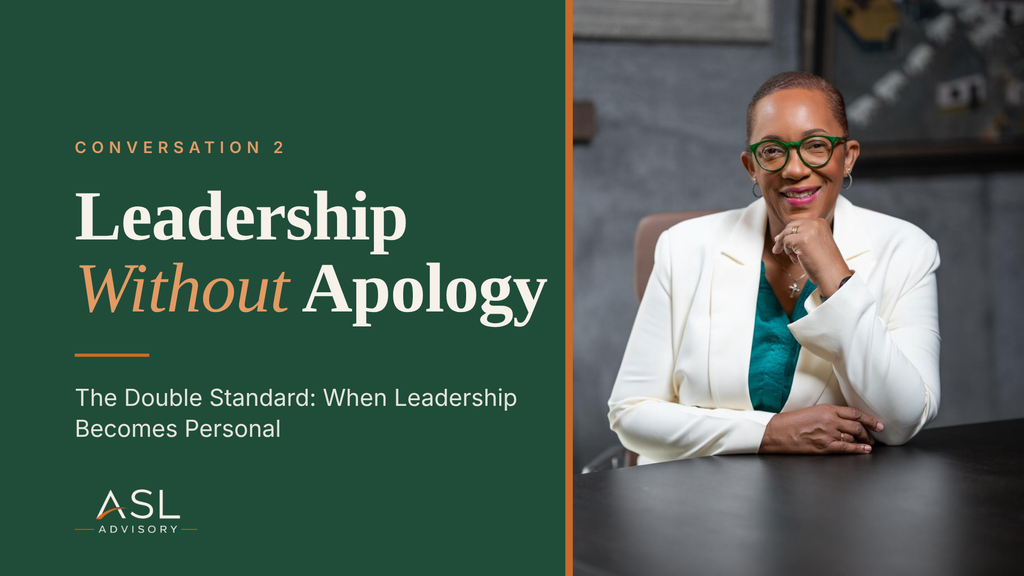
“You are too emotional.”
People have said that about me as a leader.
I have made tough decisions about people, and sometimes others saw it as, “She does not like that person.”
If I appreciated an employee who did well and met my standards, some might say I was biased.
If I worked closely with a small group of people I trusted, others might call it a clique.
Over time, I kept asking myself the same question:
Would people see these same behaviors differently if a man was the leader?
If a man relied on a strong performer, would it be called favoritism or just recognizing talent?
Would trusted advisers be seen as a clique, or as a strong inner circle?
Would a tough decision be blamed on personal feelings, or would people look at the business reasons first?
Would showing emotion be seen as a weakness, or as proof that the leader cares deeply or is passionate about the job?
Is This Real or Just Perception?
This is real, and research backs it up.
Catalyst, the global research organisation, describes it as the “double-bind dilemma”. When women leaders act in ways traditionally associated with leadership, they are often seen as competent but not likeable. When they act in ways traditionally expected of women, they are seen as likeable but less competent. Men are rarely asked to choose.
The pattern shows up in writing too. In 2014, linguist Kieran Snyder analysed 248 performance reviews from technology companies. Critical feedback given to women was far more likely to focus on personality than on performance. The word “abrasive” appeared 17 times. Every one of them was in a review of a woman.
Sometimes the Criticism Is Right
This is where we need to be careful.
Not every criticism of a woman leader is because she is a woman.
Sometimes the leader is showing favouritism. Sometimes the inner circle has become too closed. Sometimes emotion is affecting judgement. Sometimes a decision was not fair.
And sometimes, the feedback we do not want to hear is exactly what we need.
I had to take an honest look at myself. Was I holding everyone to the same standards? Was I listening to people who disagreed with me? Were the people I trusted telling me what I needed to hear, or just what I wanted? Was my emotion helping me see the human side of a decision, or was it clouding my judgment?
Being self-aware also meant admitting that I have my own biases, just like any leader, and making sure they did not affect my decisions. For important choices, especially those about people, I asked for a second opinion. Hearing another perspective helped me check if I was seeing things clearly, or just seeing what I expected.
These are the kinds of questions and habits every leader, man or woman, should practice.
Challenge the Decision, Not the Woman
But if we are going to challenge a leader, we need to be clear about what we are questioning.
Challenge my decision.
Question my judgement.
Ask whether I have applied the standards consistently.
Hold me accountable for the results.
But look at the behavior and the facts before guessing the woman’s motives.
When we go from saying, “I disagree with her decision” to “She does not like that person,”
we stop looking at the decision and start making assumptions about the woman herself.
Self-Awareness or Self-Editing?
When you hear these things often enough, something begins to happen inside.
You start asking: Am I too emotional? Too blunt? Should I soften this? Will people think I am biased? Should I distance myself from someone simply because others may misunderstand the relationship? Should I say less? Show less?
You rehearse how to disagree without seeming difficult. You soften your emails. You add “just”, “I think” and “sorry” to sentences which do not need them.
Some of this reflection is healthy. But over time, I learned there is a difference between self-awareness and self-editing.
Self-awareness asks: How can I become a more effective leader?
Self-editing asks: How much do I need to change myself to make others comfortable with my leadership?
Those are very different questions.
Women Can Carry the Double Standard Too
This is not just about how men see women leaders.
Women can apply these standards to other women. We can question another woman’s ambition. We can call her confidence arrogance. We can read her relationships with senior colleagues as political. We can criticise her for being extremely tough, then question whether she is strong enough when she shows vulnerability.
If we want this conversation to matter, we have to look at our own assumptions too.
The Answer Is Not to Become Harder
Women moving into senior leadership often get the message that to succeed, they need to be tougher, more controlling, and less themselves.
I do not believe that. Nor do I believe the answer is to ignore feedback and say, “That is just who I am.”
Good leaders adapt. Experience has changed how I communicate, listen, handle conflict, and make decisions. But adapting should make us better, not less authentic.
We can be firm without being stern.
Confident without needing to dominate.
Empathetic without avoiding difficult decisions.
Open to challenge without surrendering our judgement.
These are simply the marks of good leadership, whoever is leading.
And organisations have work to do, too. Who do we instinctively see as authoritative? Whose ambition do we celebrate? Who gets described as having “leadership potential”? When two leaders behave the same way, do we judge them the same way?
If you lead others or write performance reviews, try this simple test: Before you comment on a woman’s personality, ask yourself, “Would we say the same about a man?”
What Have I Learned?
Listen to feedback.
Examine yourself honestly.
Seek a second opinion when the decision matters.
Change when change will make you a better leader.
But develop the discernment to recognise when feedback is helping you grow, and when an expectation is simply asking you to become a more comfortable version of yourself.
Growth should expand your leadership. It should not erase you.
In Conversation 1, I asked whether we had given women more seats at the table or more say at it. This week’s question is harder:
How do women stay open to honest feedback without letting double standards make them second-guess their own judgement?
And for those of us who lead, develop or evaluate others:
Are we judging the leadership, or the woman?
I would love to hear your thoughts.
